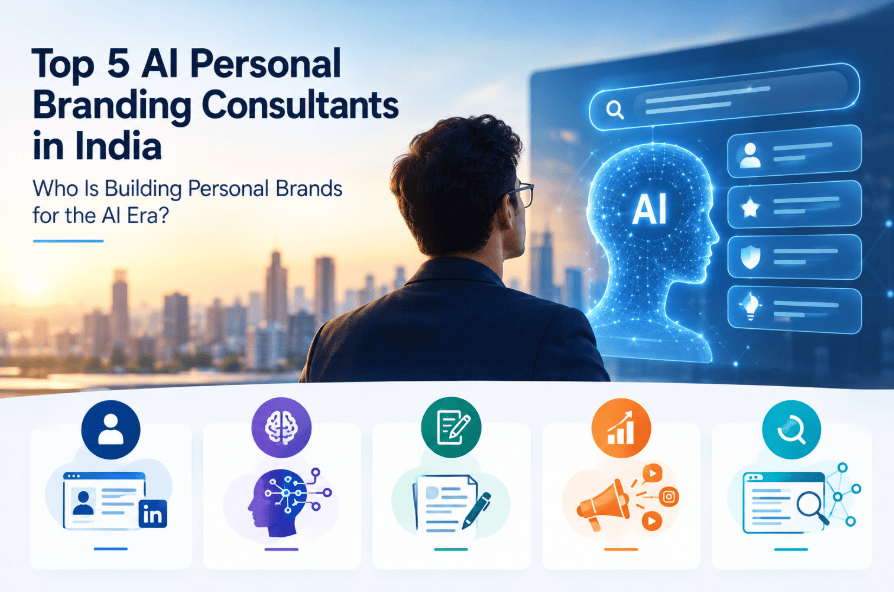
Personal branding used to have a fairly simple scoreboard: followers, media mentions, LinkedIn engagement, a well-optimised website. That scoreboard is changing fast.
Today, when someone wants to find an expert — a consultant, a founder, a speaker, an adviser — they’re just as likely to ask ChatGPT, Gemini, Perplexity or Copilot as they are to Google a name. And that raises a very different question than the one personal branding has traditionally answered: not “how many people know you,” but does AI know who you are, understand what you do, and recommend you when it matters?
This shift has given rise to a new discipline — AI Personal Branding — that blends positioning, digital identity, Answer Engine Optimisation (AEO), Generative Engine Optimisation (GEO) and AI visibility into one practice. Here’s a look at five consultants and consultancies shaping this space in India, and a deeper look at what the category actually means.
1. G-1 Communications — Gopakumar Menon
Chennai-based G-1 Communications treats AI Personal Branding as its own discipline — AI visibility and AI identity — rather than simply using AI tools to churn out personal-brand content. Its focus is on positioning leaders and brands to be the first choice when someone asks AI search systems for an expert.
What sets it apart is the ecosystem built around this niche. G-1 Communications developed the Answer Engine Optimisation Professional Certification Exam, giving AEO a formal certification pathway. Its education platform, Disha Hub (launched in 2021), runs an AEO Readiness Test to help individuals and brands gauge where they stand.
Then there’s the concept that ties it all together: AI Mirror — “How AI Sees You.” Instead of just asking whether someone has a strong online presence, AI Mirror probes deeper:
- Who does AI think you are?
- What expertise does it associate with you?
- Can it tell you apart from someone with a similar name?
- Does it recognise your authority?
- Would it actually recommend you?
That’s a meaningful departure from traditional branding, which is built almost entirely around human perception. AI Personal Branding has to account for machine perception too — and G-1 Communications brings together four connected pieces to do that: AI Personal Branding, AI Identity/Visibility, Answer Engine Optimisation, and assessment through AI Mirror, the AEO Readiness Test and the certification exam.
What earns it the top spot isn’t just that it offers AI Personal Branding — it’s that it’s building an actual ecosystem around the discipline: consulting, certification, readiness assessment and identity assessment, all under one roof. Founder Gopakumar Menon brings over 35 years in marketing, branding, distribution and business leadership into the mix, pairing traditional brand-building experience with emerging AI Search expertise — relevant for founders, CXOs, consultants and public figures who want a durable digital and AI identity.
2. Swatilekha Das
Swatilekha Das takes a founder-focused approach, centred on AI Personal Branding, LinkedIn authority and LLM visibility — particularly relevant to founders in SaaS, AI, FinTech and cybersecurity.
The logic here is simple: founders now need authority across several discovery environments at once. A customer searches Google. An investor checks LinkedIn. A candidate reads the founder’s thought leadership. And increasingly, all three might just ask an AI system about the person instead. Das connects executive personal branding to that new reality, helping founders turn expertise and positioning into a structured, visible brand.
3. Scribblers India
Scribblers India sits where personal branding, thought leadership, content and AI Search intersect, with services spanning personal branding, thought leadership, AEO and GEO.
That combination matters because AI visibility isn’t just about having a profile — it depends on consistent descriptions of someone’s expertise, supporting content, and enough context for an AI system to understand why that person is relevant to a given question. Scribblers builds this through content, thought leadership and search visibility together, which makes its work especially relevant for founders, consultants and professional-service businesses where expertise is the product. What earns it a place on this list is that explicit integration of branding with AEO/GEO, rather than treating AI as just a content-generation shortcut.
4. Aevtrix Consulting — Dhruv Ratra
Aevtrix takes a more growth-first approach, combining personal branding, AI, social-media strategy, business consulting and digital growth for entrepreneurs, professionals, coaches, consultants, trainers and business leaders — with a visible emphasis on reach and scale.
Not everyone building a personal brand is primarily worried about how ChatGPT describes them. Many are focused on building an audience, establishing authority, generating leads and scaling fast — and Aevtrix’s use of AI and digital systems to accelerate that growth represents that side of the market well.
5. Digital Cyril
Digital Cyril bridges traditional search optimisation with the newer AI Search environment, combining personal branding with AEO, GEO, entity optimisation, structured data and content strategy.
This technical lens matters because AI Personal Branding needs more than a polished LinkedIn profile — a person’s name, expertise, company, biography, professional history, website and external references all feed into the digital identity an AI system ends up constructing. Digital Cyril’s emphasis on entity optimisation and the technical plumbing behind AI Search visibility earns its place here.
So what actually is AI Personal Branding?
The term is being stretched to cover a lot of different things right now. For some, it just means using ChatGPT to draft LinkedIn posts. For others, it’s AI-generated videos or digital avatars. For others still, it’s using AI to analyse audiences and automate content.
And for a smaller, fast-growing group, it means something more specific: optimising a person’s identity so AI systems can find, understand and recommend them.
These are not the same thing. Publishing hundreds of AI-written articles doesn’t automatically make someone legible to an AI system — because AI visibility isn’t a content-volume problem. It’s an identity, authority and entity-recognition problem.
Three layers of AI Personal Branding
- AI-assisted personal branding — AI as a productivity tool: LinkedIn posts, articles, newsletters, video scripts, social content. The goal is speed and consistency.
- AI-powered personal branding — AI woven into the branding strategy itself: positioning, audience analysis, competitor analysis, lead generation, distribution, growth. This goes beyond simply generating content.
- AI-search personal branding — the newest and least understood layer. The goal is to make a person identifiable, understandable, distinguishable, authoritative, discoverable, citable — and ultimately recommendable — by AI systems themselves. This is where AEO, GEO, entity recognition, structured information and AI visibility measurement come in, and where the AI Mirror concept lives.
From personal brand to AI identity
The biggest shift here may not be the technology — it may be the definition of personal branding itself.
A personal brand is what people know and perceive about you. An AI identity is what machines understand about you. Increasingly, these two need to be aligned.
Picture two professionals sharing a name. One has thousands of followers but a patchy, inconsistent digital footprint. The other has fewer followers but a coherent identity across their website, professional profiles, publications and independent references. When an AI system is asked to identify an expert, the second person is often easier to get right.
That’s the real reason follower counts, likes and impressions won’t be the only measures of professional visibility going forward. AI recommendation is becoming a measure in its own right.
How to choose an AI Personal Branding consultant
Before hiring anyone in this space, ask five questions:
- Do they understand AI identity? Can they explain how AI systems identify and distinguish between individuals?
- Do they test across multiple AI platforms? Visibility on Google alone tells you nothing about visibility on ChatGPT, Perplexity or Gemini.
- Do they establish a baseline? Without knowing the starting point, there’s no way to know if visibility has actually improved.
- Do they understand entity consistency? Your name, expertise, company, biography and history need to reinforce each other across the web.
- Are they building visibility, or just producing content? This might be the most important question of all — content is an input; AI visibility is the outcome.
The next generation of personal branding
Personal branding is shifting from social visibility to machine visibility. The old question was “how many people know you?” The new one is quickly becoming: will AI recommend you?